


There are seasons in life when everything feels like too much.
Your mind is constantly racing. Your emotions feel close to the surface. You find yourself reacting to things that normally wouldn't bother you, feeling exhausted even after resting, or carrying a heaviness you can't quite explain.
From the outside, life may look completely fine.
But inside, something feels off.
You may feel disconnected from yourself, uncertain about what you need, or stuck in survival mode—just trying to get through the day.
If this sounds familiar, you're not broken.
You're likely overwhelmed.
And when life becomes overwhelming, the answer isn't to push harder, do more, or force yourself to have everything figured out.
The answer is often much simpler: You need to come back home to yourself.
What Does It Mean to Come Back Home to Yourself?
Coming home to yourself means reconnecting with the part of you that exists underneath the stress, expectations, responsibilities, and emotional noise.
It's remembering who you are beneath the overwhelm.
It's learning how to pause long enough to hear your own needs again.
It's creating space to feel what you're feeling instead of constantly pushing it away.
Many people spend years trying to fix their lives without realizing they've become disconnected from themselves in the process.
They chase answers.
They seek certainty.
They try to control outcomes.
But the deeper healing often begins when they stop running and start listening.
Coming home to yourself isn't about becoming someone new—it's about reconnecting with who you've always been.
Signs You've Become Disconnected From Yourself
Disconnection rarely happens overnight—it usually happens slowly through chronic stress, emotional overload, people-pleasing, burnout, grief, major life transitions, or simply spending too much time focused on everyone else's needs.
Some common signs include:
Feeling emotionally exhausted for no obvious reason
Constantly overthinking everything
Struggling to identify what you're feeling
Feeling numb, disconnected, or checked out
Losing interest in things you once enjoyed
Feeling irritated, reactive, or easily triggered
Ignoring your own needs while caring for everyone else
Feeling stuck even though you're trying hard to move forward
Craving peace but not knowing how to find it
These experiences are often signals that your nervous system, emotions, and inner world are asking for attention.
Not judgment.
Attention.
Why We Lose Ourselves During Difficult Seasons
When life feels overwhelming, our brains naturally shift into protection mode. We become focused on managing responsibilities, solving problems, and getting through whatever challenge is in front of us.
While this survival response is helpful in the short term, it often comes at a cost.
We stop checking in with ourselves.
We ignore our emotions.
We disconnect from our bodies.
We push through exhaustion.
We tell ourselves we'll slow down later.
But later rarely comes. Eventually, the stress accumulates. The emotions build. The overwhelm grows louder. And our inner world begins asking for our attention in ways we can no longer ignore.
The First Step Is Not Changing Your Life
Many people believe the solution is to make a dramatic change.
Quit the job.
End the relationship.
Move somewhere new.
Start over.
Sometimes those changes are necessary. But often the first step isn't changing your life.
The first step is creating enough stability inside yourself to hear what your life is trying to tell you.
Before clarity comes regulation.
Before transformation comes awareness.
Before growth comes grounding.
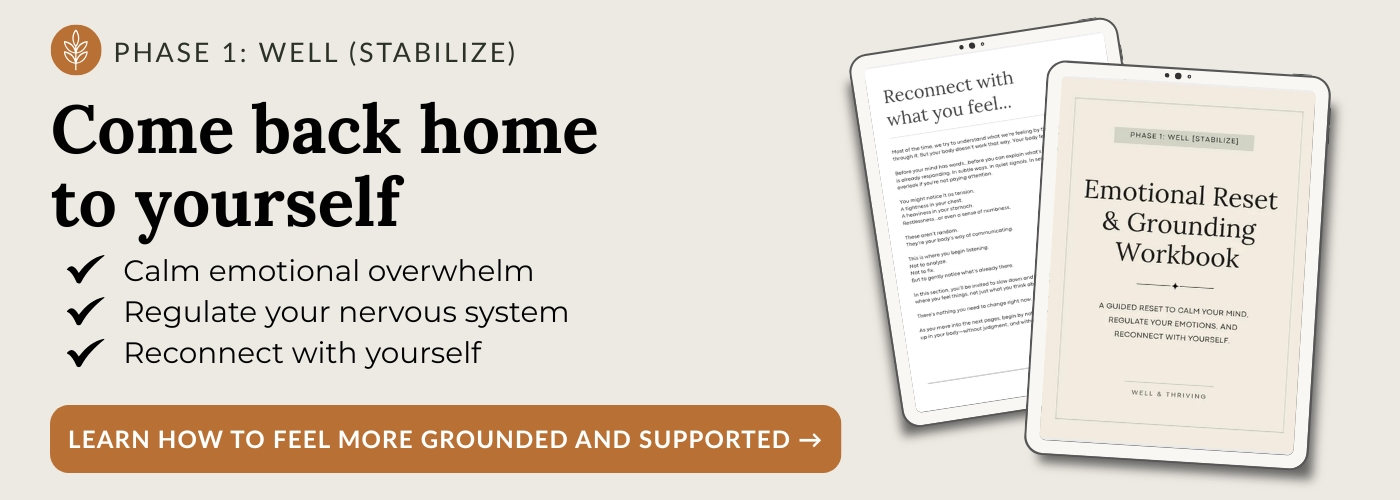
This is why the first phase of healing isn't about becoming—it's about stabilizing.
Four Ways to Start Coming Back Home to Yourself
Slow Down Long Enough to Notice What's Happening
Many of us spend so much time distracting ourselves that we never actually check in.
Pause for a moment and ask yourself:
What am I feeling right now?
What has been weighing on me lately?
What do I need more of?
What do I need less of?
You don't need perfect answers.
You simply need awareness.
Reconnect With Your Body
Overwhelm often pulls us into our minds. Grounding brings us back into our bodies.
Try:
Taking a short walk outside
Sitting quietly in nature
Deep breathing exercises
Stretching
Placing your hand over your heart and simply noticing your breath
Small moments of presence help signal safety to your nervous system.
Give Yourself Permission to Feel
Many people spend years trying not to feel difficult emotions. But emotions that aren't acknowledged don't disappear. They often become stress, anxiety, tension, or emotional exhaustion.
Instead of asking, "How do I make this go away?"
Try asking: "What is this feeling trying to tell me?"
Stop Trying to Fix Everything Today
Healing isn't a race. Growth isn't a checklist.
Coming back home to yourself happens through small moments of reconnection repeated consistently over time.
You don't need all the answers today.
You only need the next step.
You Are Allowed to Begin Where You Are
One of the biggest misconceptions about healing is that you need to have everything figured out before you start. You don't.
You don't need a five-year plan.
You don't need certainty.
You don't need to know exactly where you're going.
You simply need to be willing to reconnect with yourself one moment at a time.
Because beneath the overwhelm, the stress, the confusion, and the emotional noise...
You are still there.
Your wisdom is still there.
Your strength is still there.
Your authentic self has never left.
Sometimes it simply needs space to be heard again.
Your Next Step
If life feels emotionally overwhelming, mentally exhausting, or internally chaotic, start by focusing on stability before trying to create change.
The Well & Thriving Method begins with Phase 1: WELL (Stabilize)—a guided approach designed to help you regulate your nervous system, reconnect with yourself, process emotional overload, and create a foundation for deeper healing and growth.
Because transformation doesn't begin by becoming someone new. It begins by coming back home to yourself.